Earlier this week we wrote about what we are building and why. This is the same hot work permit at a whiteboard: who is involved, how the permit window works and where we still have open questions. It takes ten minutes. Do you weld, insure or answer for hot work at your sites? Then tell us what we missed.
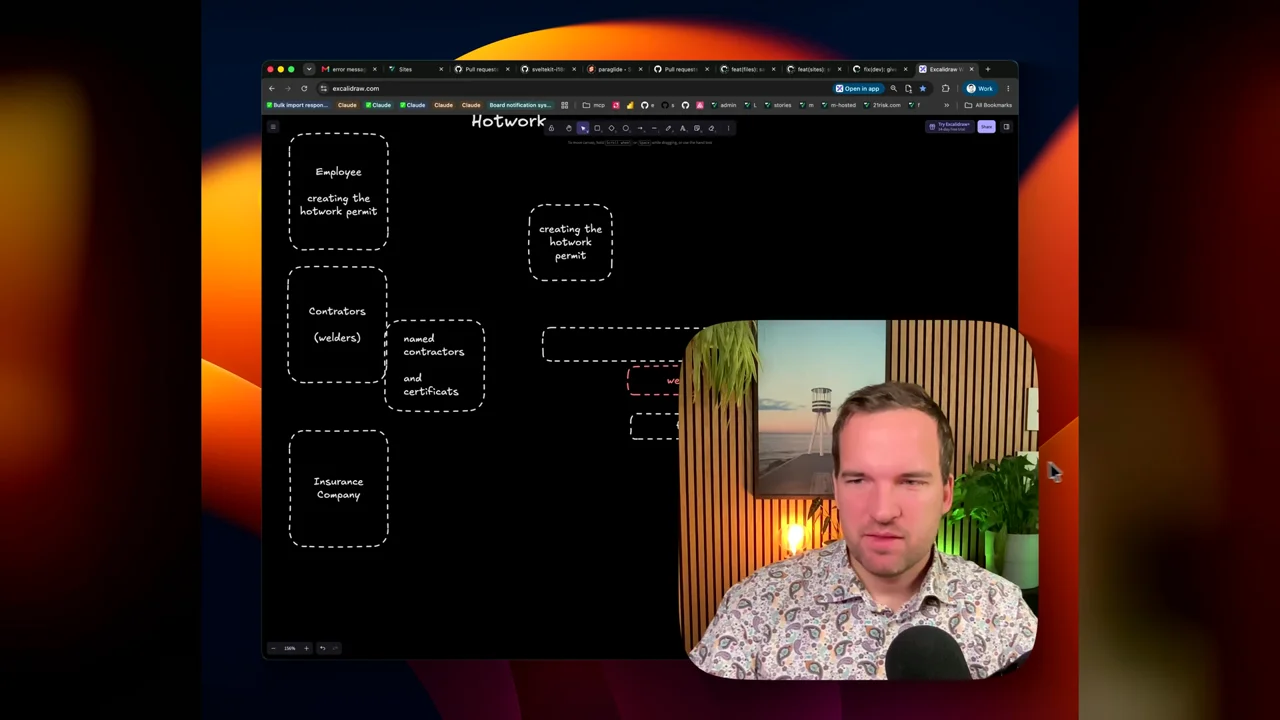
Who is involved
Three parties meet in a hot work permit. The employee at the site creates the permit. The contractor does the cutting or welding. The insurer wants to know that both did their part.
We want named contractors on the permit, not just the company. The person who welds is the person whose certificate counts.
The permit window
A permit opens a window in which hot work is allowed. The work is only part of it. When the welding stops, the fire watch starts. The fire watch checks in while it runs. How long the watch runs and how many check-ins it takes depend on the site's procedure: one check-in in some cases, ten in others.
The whole job should fit in the window: the work, the fire watch and its check-ins. So 21RISK should stop new work from starting so late that the fire watch can't finish in time. How long the welding takes is only half the question. A watch that has started still keeps running if the permit expires. When more work is needed later in the day, you start a new round of hot work with its own fire watch.
Different rules for every site
Many large companies run sites in both the US and the EU. Local rules and recommended guidelines differ between them. Insurers add their own requirements. Then there are the edge cases, such as historical buildings.
So we are testing a different start. The employee writes the request in plain words: "Today Michael from Best Welders will do hot work. He will be done by 15:00, and Anders will be the fire watch." An AI reads the request together with the site's policies, its location and the type of work. It proposes the permit window, the fire watch periods and the check-ins. They follow the rules for that site, that kind of work and that insurer. If it needs more information, it asks first. People still decide and sign.
Escalation and impairments
The last part of the whiteboard is escalation. When a check-in is missed, who is told and how? What changes when sprinklers or smoke detection are turned off? We want this part to follow how your sites already work.
Where we need your input
- Certificates. How do contractors show their hot work certificates today? Do they carry paper or a plastic card? Is it digital, with a QR code?
- Rules. Which rules do your sites follow when your own procedure, local guidance and your insurer say different things?
- Escalation. Who should hear about a missed check-in, and how fast? What should happen while fire protection is impaired?
Tell us what we missed: talk to us.
Be first
Hotwork permits are coming to 21RISK. We will share a date once we are sure of it. Join the hotwork waitlist, and you hear first.